
Research thrusts.

Thrust 1: Additive manufacturing of metals and ceramics

The PI's laboratory has access to multiple instruments, including friction surfacing, an ink-extrusion printer, and laser powder bed fusion, for additive manufacturing of metals and ceramics with intricate structures through solid- and liquid-state processing.

A. Direct Ink Writing

Direct Ink Writing (DIW) enables the additive manufacturing of intricate 3D structures via layer-by-layer deposition. Unlike fusion-based techniques, DIW processes a broad range of materials, including metals, ceramics, and polymers, at lower temperatures using compact, energy-efficient hardware. This method allows printing and synthesis of air-sensitive materials with 3D structures for enhanced functionality. High-entropy superalloys and thermoelectric materials have been printed and synthesized via DIW for high-temperature applications.
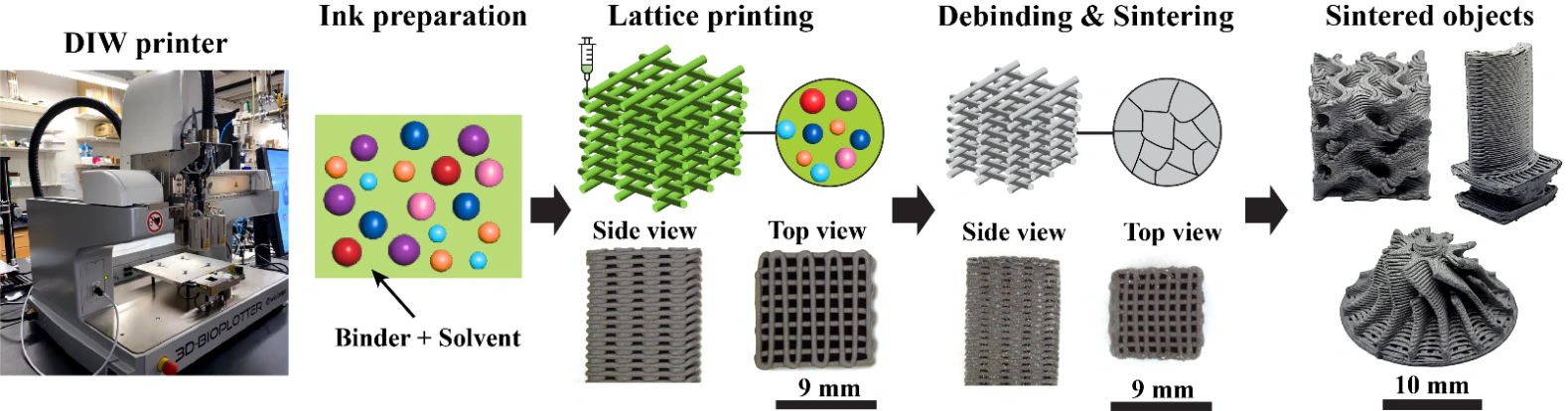
Direct ink writing workflow from ink preparation and lattice printing through debinding, sintering, and finished metal or ceramic structures
Direct ink writing 3D printing of metals and ceramics with intricate structures.

B. Laser powder bed fusion

Laser Powder Bed Fusion (L-PBF) enables the 3D printing of metals, ceramics, and polymers with intricate geometries and high-dimensional precision. The use of selectively blended powders in the L-PBF process can eliminate the need for pre-alloying steps in traditional powder metallurgy, thereby reducing both cost and energy consumption.
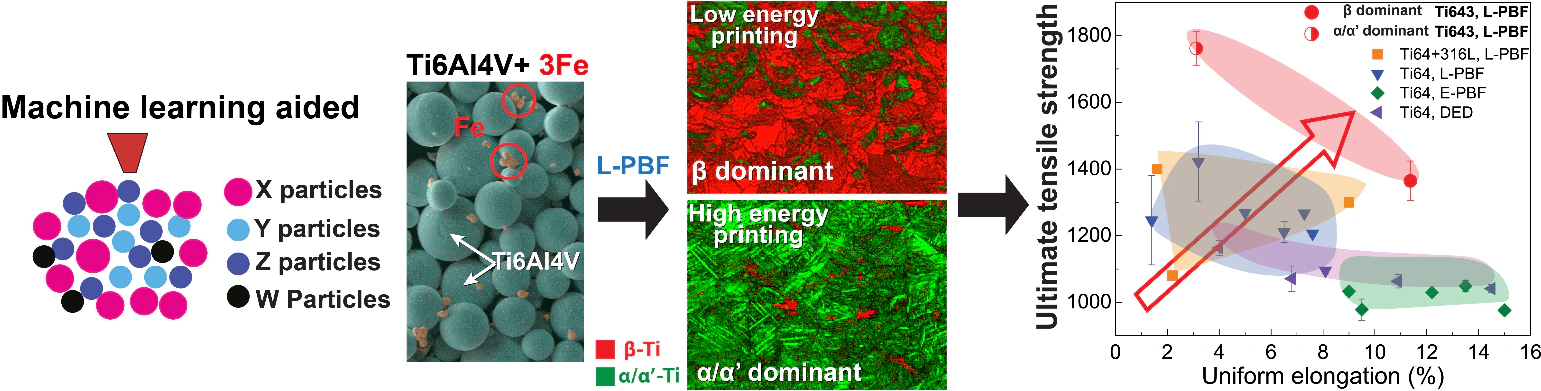
Laser powder bed fusion workflow using blended titanium and iron powders to control phases and tensile properties
Laser powder bed fusion of titanium alloys with designed microstructures and phases for enhanced mechanical properties.

Thrust 2: Hierarchical porous materials

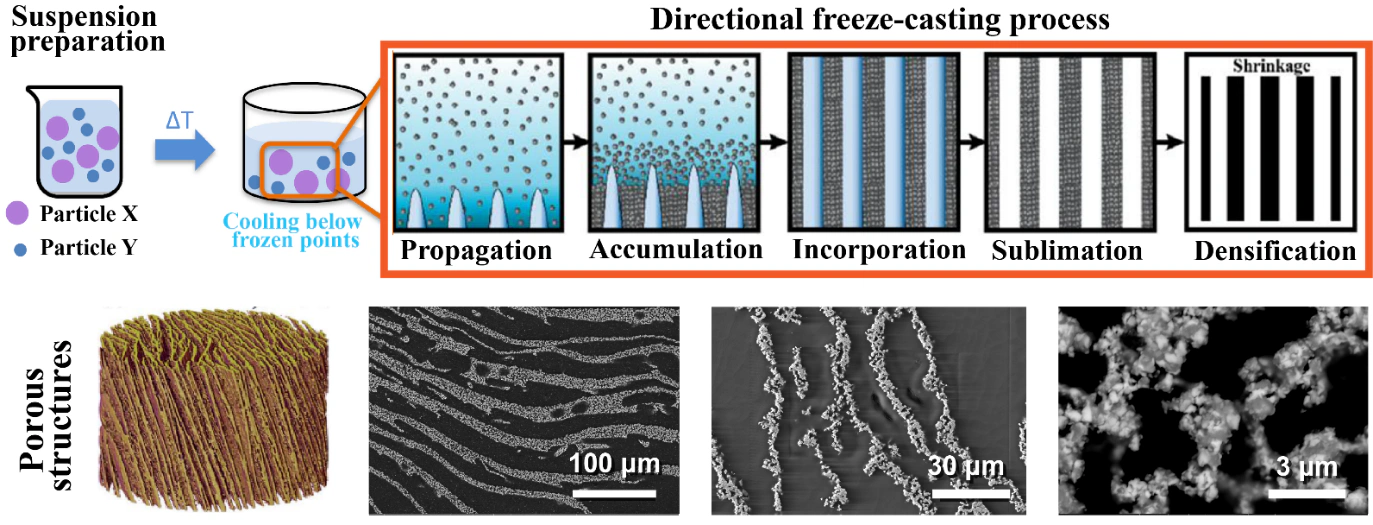
Porous materials with hierarchical porosities offer a high surface area to facilitate chemical reactions and exhibit unique mechanical properties compared with their dense counterparts. These structural advantages make them ideal for a wide range of applications, including energy storage, filtration, and biomedical implants. Hierarchical porosity can be achieved through directional freeze-casting, a low-cost manufacturing technique capable of producing fine, aligned pore structures with channel widths as narrow as 20 µm. Future research will further harness the potential of the freeze-casting technique to design and fabricate porous architectures for both energy-related and biomedical applications.

Thrust 3: Critical minerals and materials processing

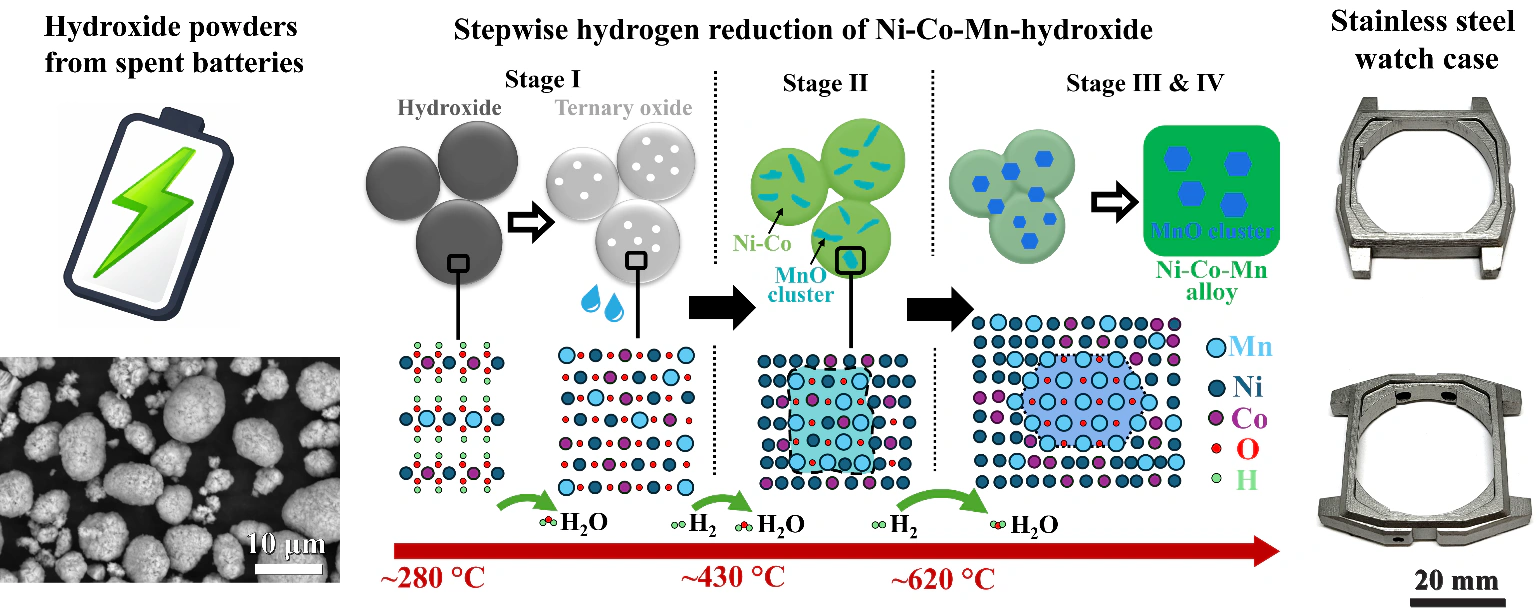
We focus on transforming mineral resources, industrial byproducts, and end-of-life materials into high-value metals, alloys, and functional materials through thermochemical processing, hydrogen-based reduction, and microstructure engineering. In a recent publication, we demonstrated the direct hydrogen reduction of mixed Ni-Mn-Co black-mass-derived precursors into a reusable master alloy for stainless-steel production. This work advances a circular materials framework that connects critical-metal recovery with scalable alloy manufacturing.

Hydrogen reduction of battery-derived nickel, cobalt, and manganese precursors into an alloy used for stainless-steel manufacturing
A sustainable, carbon-free metallurgical pathway linking two previously unrelated processes - battery recycling and sustainable steelmaking - while integrating resource circularity, critical-metal recovery, and decarbonization across two major industries.

Thrust 4: Mechanical properties at micro-/nano-scales

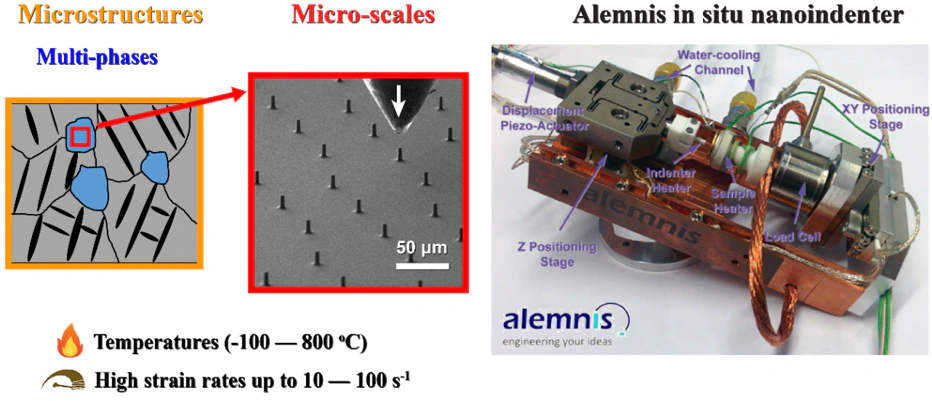
At the micro-scale, in situ micro-/nano-mechanical testing was performed inside a scanning electron microscope (SEM) to study the effects of high temperature, sample size, and ion irradiation on materials including brittle silicon, diamond, germanium, and ductile magnesium alloys. Strength, fracture toughness, and dislocation activation energies have been measured on specimens at micro-/nano-scales over a wide temperature range, from cryogenic to elevated temperatures (-100-800 °C). High-resolution transmission electron microscopy (TEM) is used to study dislocation-mediated deformation mechanisms.

Build what comes next

Curious about how materials are made - and why they perform?

The PPM Lab welcomes inquiries from motivated Ph.D. students, postdoctoral researchers, and summer interns.

Join the group